
Science Highlight
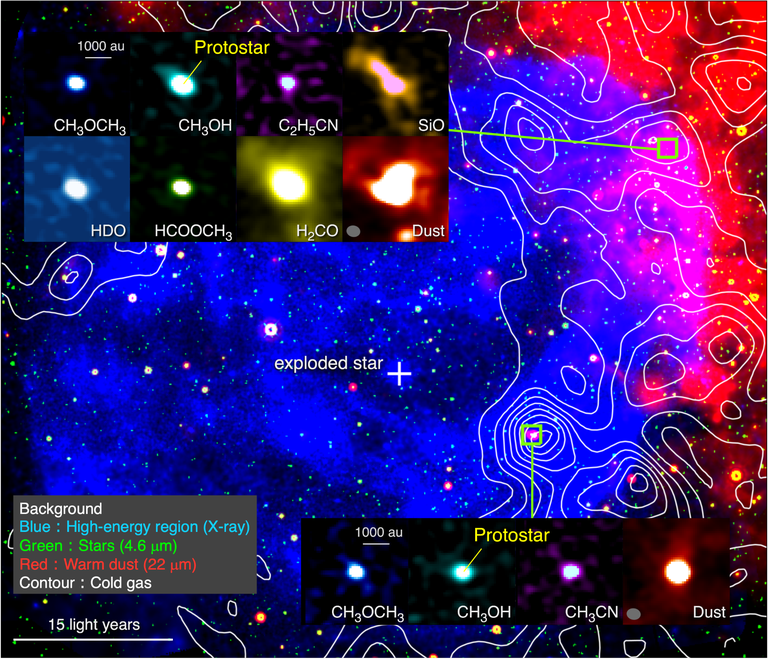
In a recently published paper, Shimonishi and collaborators make use of ALMA to discover two hot molecular cores associated with young stars inside the supernova remnant RX J1713.7−3946. This is the first detection of hot molecular cores in a region directly affected by supernova feedback.
Hot molecular cores are compact, warm, and dense regions surrounding newly formed stars and are characterized by rich molecular chemistry. In one of the newly discovered sources, RX 1713 HC1, ALMA detected a wide variety of carbon-, oxygen-, nitrogen-, sulfur-, and silicon-bearing molecules, including complex organic molecules. The molecular gas is dense, compact, and warmer than 100 K, confirming its nature as a hot core. Remarkably, despite its location within a harsh environment exposed to energetic radiation and particles from the supernova remnant, the chemical composition of HC1 is similar to that of hot cores and hot corinos found in more typical star-forming regions. This suggests that molecular complexity associated with star formation can survive, at least for some time, even under strong supernova feedback. Protostellar cores near supernova remnants are also of particular interest because they may provide clues to the environment in which our own Solar System formed.
The main publication is Shimonishi et al. (2026), “Survival of Molecular Complexity under Recent Supernova Feedback: Detection of Hot Cores in RX J1713.7−3946,” published in The Astrophysical Journal (DOI: 10.3847/1538-4357/ae6fba). This work was supported by JSPS KAKENHI grant Nos. 20H05845, 24H00246, 25K07364, 25K07367, 26K00761, and 26K22372, the Uchida Energy Science Promotion Foundation, the ALMA Japan Research Grant of NAOJ ALMA Project, NAOJ-ALMA-397, and the NAOJ ALMA Joint Scientific Research Program (2024-27B).